What to expect from a hoarding cleanup, from first call to final walkthrough
By Amara Whitfield · Updated 2026-05-24

A hoarding cleanup can feel overwhelming before it starts, mostly because it is hard to picture what actually happens. Breaking it into stages makes it far more manageable, and it also gives you a clear way to judge whether a hoarding cleanup provider is doing the job properly.
Stage one: the first call and assessment
Most providers start with a conversation, either by phone or through photos, to get a rough sense of property size, clutter severity and any biohazard concerns. This is not the stage where you need a perfect answer to every question. A provider experienced in hoarding cleanup knows severity is hard to describe accurately from outside, and a good one will follow up with an in-person walkthrough before locking in a final quote.
Be honest about what is going on, including pest activity, odour, or areas you have not been able to access in a while. Providers who specialize in this work have seen it before, and the accuracy of the assessment directly affects how accurate your quote and timeline will be.
Stage two: planning and scheduling
Once severity is confirmed, a provider should give you a realistic timeline. This directory’s timeline planner tool, linked from the homepage, uses property size, severity and crew size to estimate how many working days a job like yours will likely take, which is a useful number to compare against what a provider tells you.
| Severity | Typical crew pace | What it usually means for scheduling |
|---|---|---|
| Light | Fastest | Often completed in a single day |
| Moderate | Standard | Multiple days depending on size |
| Severe to extreme | Slowest | A week or more, sometimes phased |
Stage three: sorting
This is where most of the real time goes. Items get separated into categories, keep, donate, sell, dispose, and anything of financial or sentimental uncertainty should be confirmed with you rather than decided unilaterally by the crew. If you cannot be present for this stage, ask in advance how the provider handles items they are unsure about.
Documents deserve special attention during sorting. Anything that looks like a financial record, legal paper, or identification should be set aside for your review rather than sorted alongside general belongings, since these are the items most likely to cause real problems if discarded by mistake.
Stage four: removal and disposal
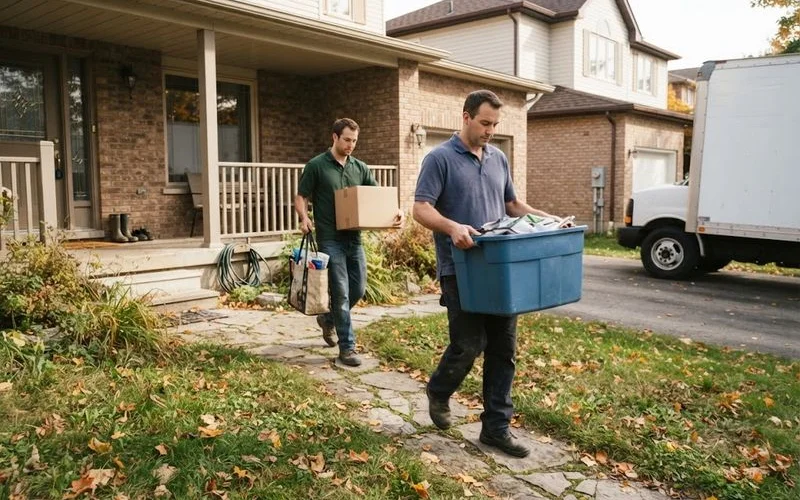
Once sorting is done, the crew hauls out everything marked for donation or disposal. This is often the fastest visible stage, since decisions have already been made and it is largely a labour task at this point.
Stage five: cleaning and sanitizing
For jobs with odour, pests, mould or other biohazard concerns, a sanitizing pass follows the physical cleanout. This can range from surface disinfecting to more involved treatment depending on what the space needs. For lighter jobs, a standard clean may be enough to finish the job.
Stage six: final walkthrough
A provider worth hiring will walk the property with you at the end, confirm everything matches what was agreed, and address any last concerns before calling the job complete. This is also the point to ask about anything that was uncertain earlier, like items set aside for your review.
Some providers also offer a short follow-up check-in a few weeks after the job, particularly for hoarding-related cleanouts where re-accumulation is a real possibility. This is not standard everywhere, but it is worth asking about if ongoing support matters to your situation.
Reviewers across this directory consistently mention crews who communicate clearly at each stage and stick to the timeline they quoted. If a provider is vague about how many stages a job will involve, or reluctant to explain their process, that is worth a follow-up question before you book.
Knowing these stages ahead of time also helps you plan your own involvement. If sorting is the part you most want to be present for, you can arrange your schedule around that stage specifically, rather than blocking off the entire job when your input matters most during just one part of it.
If the goal is a home sale rather than just clearing clutter, hoarding cleanup before selling your house covers the timeline and staging choices that matter most before listing.
For a look at how providers are scored in this directory, including thoroughness and communication, see our methodology page.
FAQ
- Do I need to be present for the whole cleanup?
- Not necessarily. Many people prefer to be there for sorting decisions but step away during the heaviest hauling and sanitizing work. A good provider will accommodate whatever level of involvement feels right for you.
- How many people work on a typical job?
- Crew size depends on the property and severity, often two to six people. A larger crew moves faster but may cost more per hour, so it is worth asking a provider how they size a crew for a job like yours.
- What happens to items that are found during sorting?
- A responsible crew separates items into categories such as keep, donate, sell and dispose, and confirms anything of uncertain value with you before it leaves the property.
- Is sanitizing always part of the process?
- It should be included or offered whenever there is odour, pest activity or biohazard concerns. For lighter jobs without those issues, a basic clean may be sufficient instead of full sanitizing.